About Me

My photo
Certified PreK-6. Masters in Child Development. Advocate for play, teacher & children choice, & the family's voice. Believe in volunteering as social justice.

Wednesday, August 21, 2013

A Space for Wonder and Risk and Relationship

I've been filled with many emotions (awe, anxiety, excitement, guilt, disbelief, un-certantity, and drive to name a few!) since accepting and starting my new job.  I'm going to put those emotions on the back burner and reflect on them in a later post.  (Especially the guilt and the disbelief; I've never had access to so many resources in a school I've worked at before.)

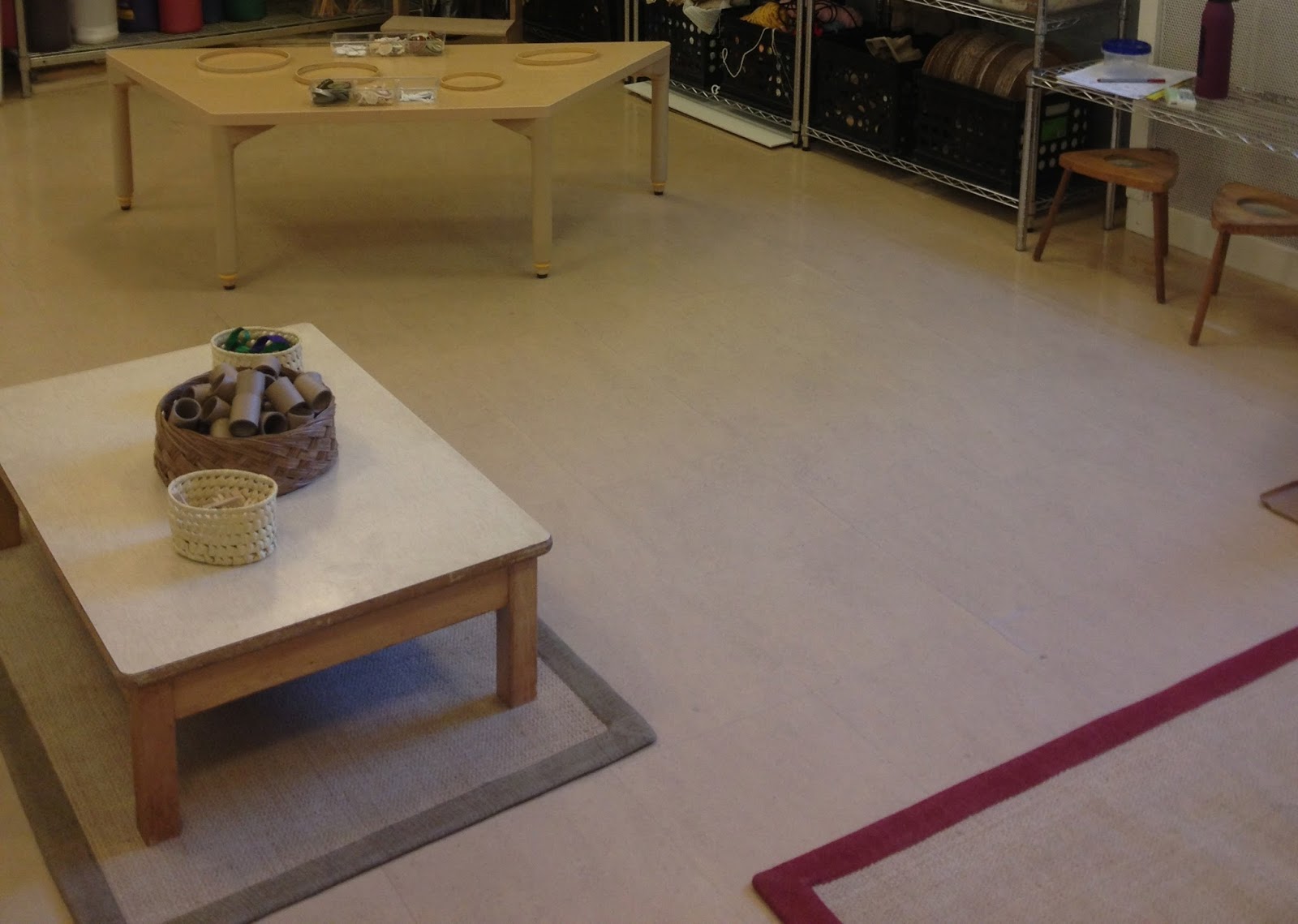
The studio space on my first day.

But those reflections are for another day.  Today I have been thinking about a lot about the studio space that I am responsible for maintaing in our Reggio-Inspired nursery school.   I've set up many early childhood classrooms; this space is different.  The studio is not a classroom and is not owned by one teacher/teaching team and class of students.

Shelves above the sinks. I place items that I hope the children and teachers  will view as beautiful and inspiring.
The studio is a collaborative space for the school community.  This idea that the studio is a community place was one of the driving forces behind the decisions I made in preparing the space for the beginning of the school year.  I want this space to be a place where all of our little students and their teachers can feel wonder and joy and curiosity.  I want them to feel compelled to touch the materials, to look up and marvel at the items above, beside, and below them, and to feel safe in taking risks and trying new things.

The studio is not a traditional classroom.  It will not be used in traditional ways.  In the studio I will work with small groups of little learners between the ages of 2 and 5 for varying amounts of time.  Some work will be projects that last for extended periods of time and involve many people contributing to their evolution.  Some projects may last only a moment and be captured only by photo.  Some work will be experimenting and tinkering and playing with space and objects in unexpected ways.  Some work will be left and returned to when the child is ready.  Some work will be left and never returned to, but perhaps adopted for play by another child.

Though I will be working with 2 year olds in the space two days a week for an extended time period, I am trying to challenge them and myself to play in new ways.  And so, even though it was offered, I turned down typical dramatic play furniture and instead am starting the year with large boxes with stools and baskets of fabric inside.
I don't yet know all of the possibilities that the studio will provide.  I do know that I will try to be observant and reflective and intentional in the ways in which I maintain the space.  I will use the space and my relationships with the children and other teachers to challenge and question and inspire new ways of looking at the world.


I made a decision not to put chairs in the studio.  Instead I set the tables low and am stacking carpet squares along the wall in a hope that the children won't feel chained to a particular spot, but will feel free to move around as the work beckons.  Should our work lend itself to it, I will raise the table legs and create an elevated space that we can stand around.  

And so the studio may be set up to welcome children, families and teachers to the beginning of the year, but it is not done.  It will never be done.  It will be always evolving and adapting as we use it for our own risk taking and learning.

Wednesday, August 14, 2013

Exploring Names


This is kind of a departure from my usual posts. As in it's not really reflective, it's more my suggestions of the way things could be.  Though, when I think about how this came up, I suppose even this is reflective.  During my graduate school internship, I was working with a group of instructional coaches who work with PreK-3rd grade teachers.  One of the coaches and I were talking about ways to help her PreK teachers understand that there is so much more that needs to be done in PreK than having children sit down and do drills on writing their names.  So this is what I came up with (based on knowledge of child development principles).  And because I do believe so strongly in play and exploration I thought that I would share it with you.  (I also believe that these are solid ideas for kindergarten as well as Prek.) 

Exploring Names in Prekindergarten: It’s Not about Name Writing

Value of Name Play in PreK
  • Recognizing one’s name helps children feel important
  • Recognizing others’ names builds community
  • Introduces concepts of print
  • Begins the process of site reading
  • Supports beginning math concepts
Fine motor skills must be developed before writing begins.
  • Focus on drawing with details (self-portraits, observation drawings in nature, sketches of creations in block area)
  • Playing with play dough (rolling with palm on table/between palms, squishing with fist, using finger and thumb to roll balls)
  • Drawing/tracing name in salt/sand trays 
  • Using tweezers to transfer object and eye droppers to transfer water
Names in daily routines:
  • Write each child’s name next to their photo and place in cubbies
  • Write each child’s name next to photo and use in home or school chart
    • Children move their name from home to school upon arrival and from school to home upon dismissal
    • Can integrate math into routine by exploring which column of chart has more names, how many children are in school, how many are at home
  • Write every child’s name on a sentence strip (or several) and laminate. Place in a basket where children can use the names to label block creations, art in process, etc.
  • If you have a word wall, the children’s names should be the first words that occupy the wall.
Name Activities:
  • Name puzzles; write child’s name on an index card, using magnetic letters/letters on bottle caps/cut up index card write name again so it can be moved around.
    • Talk about how many letters are in child’s name, what is the first letter in their name, what other letters do they see in their name
  • Tactile letters; use tactile letters that spell the child’s name for the child to finger trace.
  • Build the letters in their name with pipe cleaners.
  • Place child’s name card next to sensory bin with letters buried in sand and have child find the letters that match their name.
  • Name Sorts
    • Sort the children’s names by placing name cards under the correct letter that each name begins with.
    • Sort the children’s names by length.
    • Sort the children’s name by matching individual names to that child’s photo.
  • Create a class book with each child’s name and photo for children to read during choice time.
Writing their Names:
  • Children are ready to learn how to write their names when they 
    • are showing an interest in writing their names 
    • are holding pencils with the correct grip
    • are creating recognizable drawings
    • are able to tell you the letters in their names
  • At this time, it is important to guide children in the correct formation of the letters that make up their name.  Working individually with the children who are ready, model for them how to form each letter in their name and help them practice how to do so.

Friday, August 9, 2013

Fear: #kinderblog13 Challenge Five


Sometimes we need to push past the fear of the unknown so that we can forge our path.
This week's #kinderchat blog challenge is to write about fear.  I'm afraid of many things, some irrational and some not.  

I'm afraid to walk too close to the edge of the eL platform even after living in Chicago for 8 years because I'm convinced I'll fall onto the tracks (and that it won't be all awesome and romantic like it is in "While You Were Sleeping").  Small talk makes me frantic; I can speak eloquently about my work and child development, but talking about the weather and what teams are doing well is so awkward. Doing art in front of people makes me clammy and crazy embarrassed.  

Yet, I take the eL several times a day.  I must if I want to experience life in this crazy city I live in.  And I network and attend conferences and talk about the weather and people's children and what movie I'm planning to see over the weekend.  How else will I build relationships and make connections?  And I paint and sculpt and draw and make paper in front of both friends and strangers every day.  If I can't let go of my embarrassment over my lack of artistic talent how can I expect my students and families to take risks and try new things?

Fears are not inherently bad.  In fact, a little fear is a good thing, it provides perspective and keeps us from doing some stupid and dangerous things.  It's when the fears keep you from forging your path and living your dreams that they become a problem.  

I've been feeling a little overwhelmed (dare I say fearful) by the expectations of me and opportunities I have been given.  Parents and other professionals ask me questions about child development, I am given chances to present at conferences, and my mentors tell me they will go to bat for me in the job search and offer me opportunities to work with them.  I'm blessed.  But I'm also terrified that I will not know the answers and that I will be exposed as a fraud.  And I have to get over it.  I'll keep the fear because it keeps me modest and reflective, but I can't let it keep me from following the professional path I want to walk.

I want to grow and lead and try new professional challenges.  Fears and all.

Thursday, August 1, 2013

Dream: #Kinderblog13 Challenge Four

This is a short little post for the #Kinderchat blog challenge.  A little post on dreams.  Not the post I was going to write. But the post that I was inspired to write.  


Dreams are where ideas begin and passion grows.  Dreamers are hopeful.  Dreamers are the innovators, the artists, the advocates.  Dreamers believe that just because something is a certain way right now that doesn't mean it will always be that way.  Dreamers see the future not as something inevitable that will happen to them, but as a possibility that they can influence.  

Children are dreamers.  We can see their dreams as they pretend.  We can see their dreams as they build with blocks.  We can see their dreams as they paint and sculpt and color.  We can see their dreams as they run and dance.  We can see their dreams as they play.

And it is OUR responsibility to protect their dreams.  

It is our responsibility to protect their play.

We must. For what would the world be like without dreamers? 

Friday, July 26, 2013

Change: #Kinderchat Blog Challenge Three

I've got to hand it to my friend Amy (@happycampergirl); who knew that one word prompts could elicit such a high level of reflection?  I know that each of the prompts has elicited strong emotions in myself and I get the sense that it has in other's as well based on the content in their posts.  This week's #kinderchat blog challenge centers on the idea of change and stirs up those same strong reactions.  (Which may be why it took all week to actually write it!)

I really lucked out with this shot at the beach. It's kind of breathtaking. 
Once I got Michael Jackson's "Man in the Mirror" out of my head (drat, there it is again), I began to think about the changes in my life lately.  And there certainly have been enough of them in the past year.  Changes beyond the big ones (which I've also had too many off!) such as moving in with a roommate for the first time in years to save money and graduating grad school and saying goodbye to the people who most support me as they move across the country in search of jobs and adventure.  But also changes that were more subtle.  Changes like becoming the type of professional I want to be, learning to advocate for myself, taking chances and pushing myself to try new things in the field.  

And of course, there are still many changes still in progress.  Obviously there are the big changes still ahead (starting a new job, somewhere, sometime and starting a new decade of life), but there are also the small changes, those habits of mind, that need to be cultivated before the large changes can happen.  Specifically, I am trying to be more open minded and forgiving...of myself.  

I am constantly giving others another chance, another opportunity to grow and change, another stab at friendship when I've been let down, but I don't give myself those same passes.  When I don't interact in the manner I would like with a family at the museum, when I have an awkward interaction with a colleague, when I disappoint a supervisor; I dwell on these moments.  I agonize over these moments.  I do not let them go; I do not forgive myself.  And this is something that needs to stop.  Both for my own peace of mind, but also for my professional life.  How can I give the best of me to children and families if I don't give the best of me to me?

I am also trying to be more open minded, flexible may be a better word, in terms of my future.  At graduation, I had a strong opinion of what it is I would be doing in the next stage of my professional life.  I had come to this decision after a year of internship and fellowship and reflection.  I had a plan, darn it, and being a high achieving brat, those plans were going to happen.  Because I said so! Well, we all now what they say about man making plans.  I've spent the summer frustrated and sad and completely unsure of my future.  And then a classmate called me and told me of a job opportunity she wanted me to consider applying for.  She told me to just listen (she had been in seminar with me for a year, so she's quite familiar with my plans) because she really thinks this is a good opportunity for me to explore.  So I listened.  And I reflected.  And I decided to be more flexible in my plans and to apply for the job and see where it takes me.  Is it what I want? Not exactly, but it's also not what I don't want.  And maybe that's okay; I know my non-negotiables, those things that I definitely don't want, and this job has none of them.  In fact, parts of it are very appealing. Maybe the fact that I don't not want it is a good start to being flexible.  I have an interview Monday and as part of changing these habits of mind, I am being flexible with my thoughts going into it.  

Because, it may end up being something I do want and I can't let the fact that it doesn't fall into the plans I had in May detour me.

So, thanks for hanging in there for this rambling post on change.  But seriously, those habits of mind, I think they are the hardest things to change, but the most important.  And the same can be said for our students and colleagues.  No real change can happen until with shift our mindsets.

He had no idea that I took this photo. It's so optimistic; thought it was fitting.


Wednesday, July 17, 2013

Brag: #Kinderblog13 Challenge Two

This week's #Kinderchat blog challenge asks us to do a little bragging.  For many reasons, this is a difficult thing for me to do.  It's part personality and part not feeling as though I have anything to brag about.  This has become a problem, however, in my search for a job.  The very essence of finding a job requires bragging.  In order to get interviews I know I must write a cover letter detailing why I would be awesome for the positions.  And then I must tell potential employers that I am awesome at interviews.


And I am stuck.  Stuck at the cover letter writing stage (well, and seeing job postings for jobs I want, but that's a whole 'nother dilemma) because I feel so very very weird about bragging on my skills and experiences and trying to convince people to give me a chance.  And it's that chance I need, because I have a feeling I could do something meaningful if only I could get a job.

As I began to reflect on this week's challenge and my own weariness with "tooting my own horn", I also began to reflect on this unease as a whole within the early childhood field.  It's not news that early childhood professionals are not the best at bragging.  I know that a lot of people have a lot of different reasons for why this may be from gender to personality to the very virtues of the jobs themselves.  To be honest, I don't know why this tends to be the case, nor do I really care.  What matters to me is that we reverse this trend.  Right now.

It's an uneasy time in the world of education.  Between "reform" efforts and corporate interests in education and standardized tests and teacher bashing and the increased attention on early childhood education, people are paying attention to our field in ways that they never have before.  And we need to have a say in what people are paying attention to.  As the teachers and administrators and parents and social workers and consultants and faculty members and playmakers and everyone else out practicing and making things happen in early childhood education, we need to brag.

We need to brag about the importance of play and what that looks like in our programs.  We need to brag about the successes.  We need to brag about the little things we do that are making a difference.  We need to brag about our innovations and show that what we are doing is in the very best interest of children's development and learning.  We need to brag about the advocacy we do for children and families.  We need to brag because we need to set the tone of the conversations that everyone is paying attention to.  If we don't brag frequently and effectively, then those who are louder will overshadow us and we can't let the naysayers set the tone.  We are the professionals in the field, we are the ones who need to set the tone for children and families.

And this includes me.  If I want to do the things I say I want to do for children and families, then I need to brag too.  No matter how much I loathe it, I need to brag and get those cover letters out there.  And then I need to brag some more on behalf of the children and families and early childhood professionals so that I can help set the tone.

So here I go.  I am a reflective and thoughtful practitioner; I know that there is rarely a black or white situation and that I have to dig in the grey area to find understanding and a course of direction for the next best steps.  I believe in the importance of relationships in learning and have become skilled at making connections and looking at the larger context when working with children and families and other professionals.  I am organized; after three years of juggling graduate classes and 4 or 5 jobs at a time and an internship and volunteering I have become adapt at multitasking while still focusing on each individual task.  I can write.  I have a deep understanding of child development and have learned how to share this knowledge in ways that families and those not in the field can understand.  While juggling multiple jobs and internships I have gained an interesting intersection of experience in the policy world, the education world, and the social justice world that will be a powerful combination in my work.

Okay, that's as much bragging as I can do.  But it's a start.  Now it's your turn.  Brag.  Brag on yourselves and brag on our practice.  The conversational arc depends on it.

Monday, July 8, 2013

Confessions: #Kinderblog13 Challenge One

Nothing brings me more calm that my beautiful Lake Michigan; here's hoping it brings calm to this confession!

I have to admit that I had a crazy hard time sitting down to write this first post for the #kinderchat summer blog challenge.  I could tell you a variety of mundane confessions like I'm slightly terrified to turn 30 next month or that I cannot fall asleep without the t.v. on or how my favorite snack is still a bag of dry cheerios (toddler style).  But I am going to be brave and confess something that I've been reflecting on since the start of grad school and am still trying to find peace with.  Ready?  Please don't kick me out of our lovely little community...

I don't want to be a classroom teacher, to have my own classroom within a school or a center again.  For a girl who thought of nothing more than being a classroom teacher all through undergrad and who got a masters in child development, this is a difficult thing to admit.  For many reasons.  Because it was always the plan to be a classroom teacher, I still feel as though I am letting a lot of people down.  And obviously, I love and adore and deeply respect teachers.

The thing is, teaching in the traditional sense just isn't the direction in early childhood I want to focus.  And, of course, I want to work in the early childhood field; how could I attend the graduate program I did and not want to stay in the field.  I have a strong passion for play and learning and social justice.  This I know.  But I also know that the field of early childhood is a wide field and allows for a huge range of opportunities that are not all as classroom teachers.

I want to continue to advocate for children and families and play and learning and teachers and communities.  I want to be a source of support for those professionals who care for our littlest learners, but still need someone to coach them and guide them and advocate for them (trust me, it's quite difficult to be an infant or toddler or 3's teacher with little training or support).  I want to keep facilitating play and conversation among children and families in nontraditional settings (seriously, my job at the children's museum is still my favorite).  I want to help build bridges between home care centers and preschool centers and primary schools.  I want to use the child development knowledge crammed in my head combined with my classroom teaching experience and passions to do my part for the early childhood field.

So, no, I don't want to be a classroom teacher.  But I do want to teach.  It's just a broader definition of the word "teacher".

And while I still worry that I won't have a place to fit in or that I'll be rejected by the very same teachers I love and respect or that I'll always be working 5 part time jobs, I think I need to come to peace with my confession.

So there it is, my big early childhood confession.